
UMA Lecturer Receives Doctor of Communication Science from UI
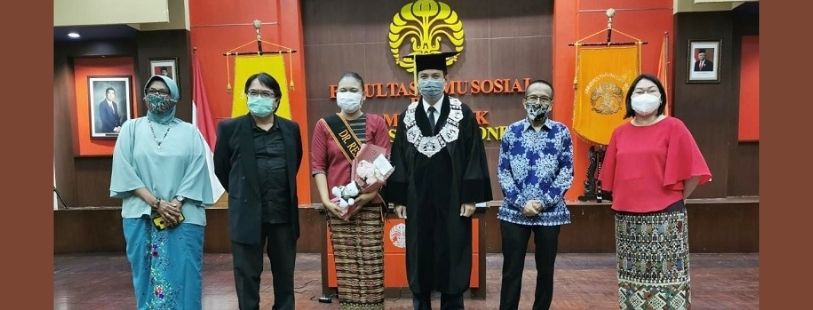
UMA‘s Lecturer with Doctoral Degree, Ressi Dwiana, officially holds a Doctor of Communication Science degree from the Faculty of Social Sciences, University of Indonesia (UI). Ressi examines the existence of community radio (RaKom) which is covered by regulations.
“In a climate of pressing regulations and a weaker civil society movement, practitioners’ efforts to maintain the existence of community radio are carried out in various ways.”
“These efforts have succeeded in making community radio sustainable. However, the main root problem of community radio, namely regulation, has never been resolved, ”said Ressi
Ressi delivered his dissertation research entitled “Setbacks of Community Radio in Indonesia (Political Economy Studies on Power Relations in Broadcasting Arrangements in Indonesia)”.

Ressi’s promoter is Dr. Ade Armando, M.S. with Kopromotor Mario Antonius Birowo, M.A., Ph.D. He successfully graduated with Cum Laude honors. The examiner in this trial was Dr. Eni Maryani, M.Si. (Padjajaran University), Dr. Irwa Rochimah, M.Si. (University of Al-Azhar Indonesia), also Dr. Nina Mutmainnah, M.Si., Dr. Pinckey Triputra, M.Sc, and Dr. Eriyanto, M.Si. from the University of Indonesia. The trial was chaired by Dr. Arie Setiabudi Soesilo, M.Sc.
This Ressi dissertation aims to explain how the efforts of community radio supporters trying to maintain the existence of broadcasting in the midst of regulatory conditions that complicate community broadcasting. Regulations, in the form of legal products and the process of their implementation, are assumed to be the main cause of the decline of community radios.
The conclusion of this research is that Law no. 32/2002 contains flexible regulations on community radio, with the assumption that the implementing regulations (PP) can be derived in more detail. But PP No. 51/2005 actually provides a regulation that is very pressing on community radio life.
Some of the rules that are opposed by community radio supporters are: the obligation to be a cooperative or association; broadcast radius limitation of 2.5 km; frequency allocation is regulated by a Ministerial Regulation; and permits and license extensions are submitted to the Minister and granted by the Minister, KPI is only an intermediary. Apart from regulatory pressures, community radio is also affected by the external climate.
INDONESIAN VERSION

You may also like
Efektivitas Administrasi dengan Enterprise Resource Planning (ERP)
Tantangan Penerapan IT dalam Bidang Administrasi